
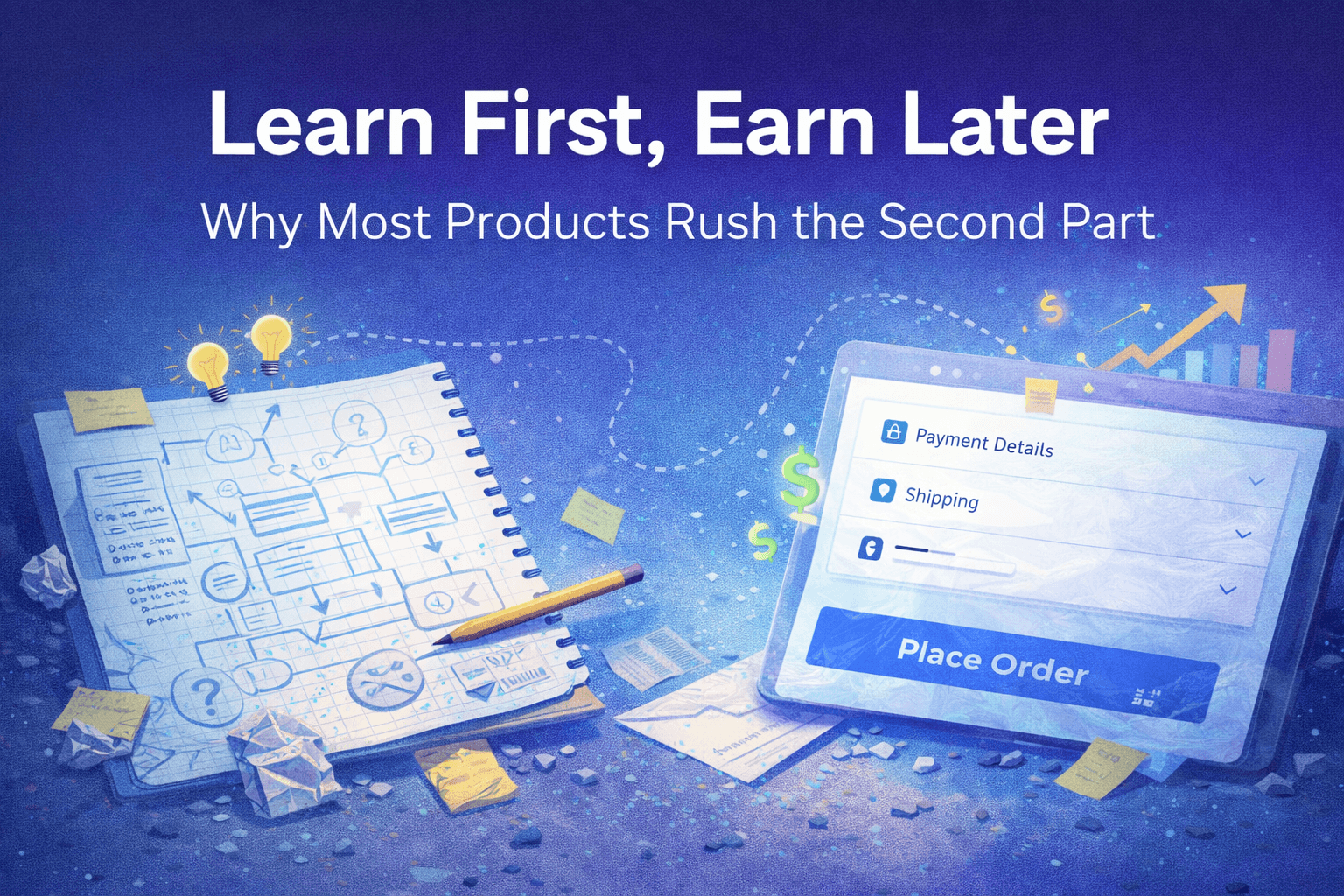
Most product people understand this idea on paper:
In discovery, you’re building to learn.
In delivery, you’re building to earn.
But it’s easier to understand than it is to actually do.
Here’s a simple way to think about it.
Imagine early Notion.
Not the polished workspace you see today.
The messy one.
At the beginning, Notion wasn’t trying to be “the best productivity tool.”
It was experimenting with blocks.
Text blocks. Table blocks. Toggles. Databases that barely made sense.
Some things stuck. Some things confused people. Some things got ripped out entirely.
That phase wasn’t about making money.
It was about learning how people actually thought and worked.
Only after that did Notion start tightening things.
Improving performance. Scaling teams. Selling to companies.
That’s building to learn first. Then building to earn.
Stripe went through the same thing.
Early Stripe wasn’t focused on dashboards, billing plans, or enterprise sales.
It was obsessed with one question.
Can a developer accept payments with a few lines of code?
Everything else came later.
Invoicing. Subscriptions. Fraud tools.
They learned first. Then they earned.
Now contrast that with what a lot of teams do today.
They start with a roadmap.
Features. Timelines. Revenue projections.
They’re trying to earn before they’ve learned.
And that’s where things get painful.
I’ve seen this firsthand. You think a feature is small. It looks obvious on the roadmap.
Then you build it.
Suddenly there are edge cases. UX questions. Behavior you didn’t anticipate. Weeks disappear.
Sometimes that depth is worth it. Sometimes it’s a dead end.
You don’t know until you touch it.
Marketing works the same way.
People want to automate funnels or outreach before they’ve ever run it manually.
But you can’t automate something you don’t understand.
You have to do it. Feel where it breaks. Notice where people hesitate.
Only then does automation help.
That’s why discovery work should feel different than delivery work.
Discovery looks like:
Rough drafts
Half-built ideas
Things you throw away
Delivery looks like:
Polish
Scale
Systems you defend
Problems happen when teams mix the two.
They treat learning like delivery. They protect features instead of questioning them. They mistake activity for progress.
What’s changed recently is how cheap learning has become.
With vibe coding tools, you can describe an idea in plain English.
Spin up a working version. Let people use it. See where they get stuck. Then decide if it deserves to move into delivery at all.
You don’t have to guess anymore. You can learn by doing.
That boundary matters.
Learn first. Earn second.
If you’re building something right now, here’s the question worth asking.
Are you trying to earn from something you haven’t finished learning yet?
That answer usually explains where things feel heavy.
Talk soon, Jason