
We ran into this a few times building funnels for clients.
We’d help them put together a solid offer.
High-ticket. Well thought out. Actually solved a real problem.
But the front end?
It was always inconsistent.
Some weeks leads would come in. Some weeks… nothing.
At the time, we thought it was a traffic problem.
It wasn’t.
What we realized later is simple:
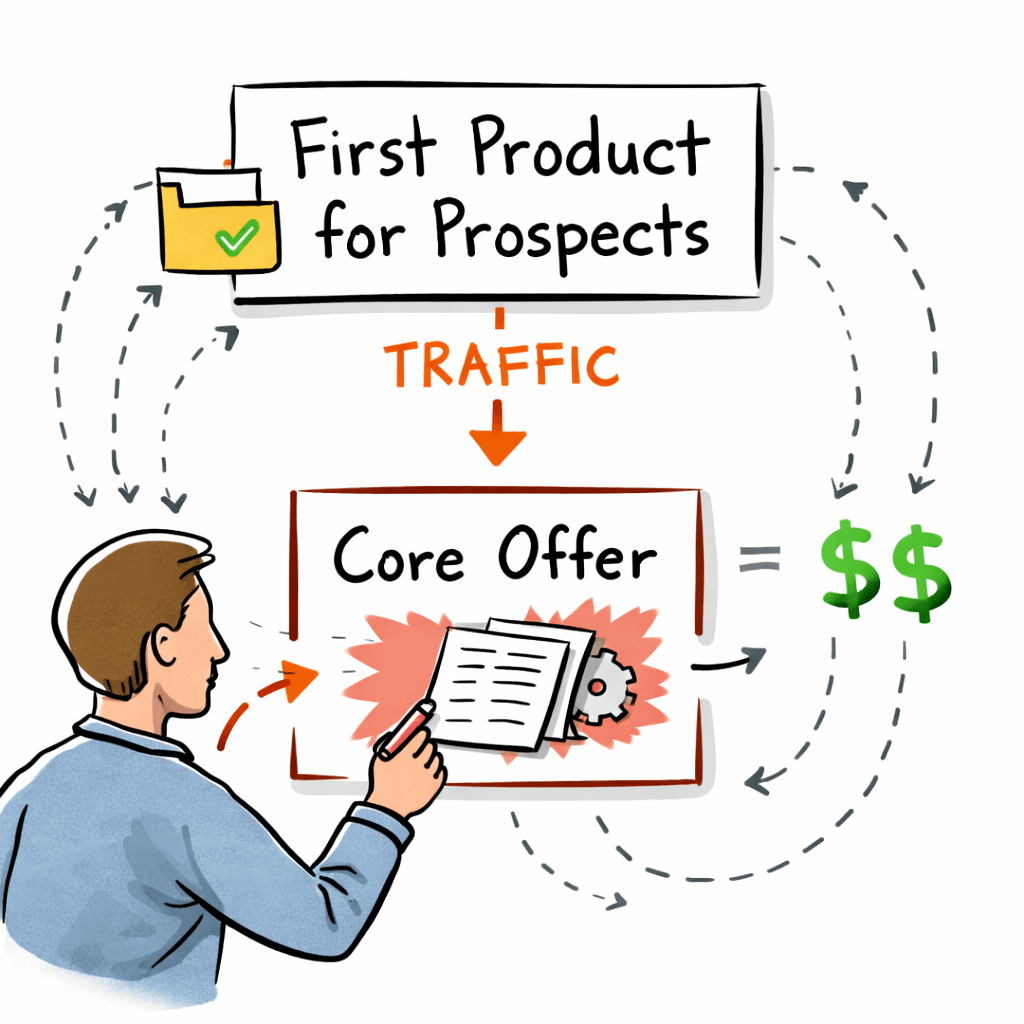
Most businesses try to sell their core offer to people who have never experienced anything from them before.
That’s a hard jump.
So we started structuring things differently.
Two products instead of one.
The first is for prospects.
Something simple. Low friction. Quick to build.
A lead magnet. A small vibe-coded tool. A quick AI workflow.
Something useful they can get value from immediately.
The goal isn’t to make money.
It’s to give someone a first experience with how you think and how you solve problems.
A small win.
The second is your core offer.
This is the thing that actually transforms the client.
Your coaching. Your service. Your system.
The thing people pay for.
The thing that solves the real problem.
We didn’t invent this.
It’s been around for a long time.
Even in older funnel models, this showed up as “product splintering” where you’d take a piece of the main offer and turn it into something simple to get people in the door.
What’s changed now is how fast you can build that first product.
With AI, you can spin up something useful in a day.
A tool. A workflow. A mini system.
No long build cycles. No waiting months to launch.
The pattern we keep seeing:
The businesses that grow cleanly…
Don’t try to sell immediately.
They create an entry point.
Then they build the relationship. Then they sell the real thing.
If your pipeline feels inconsistent…
Or everything depends on you manually closing deals…
There’s a good chance you’re missing that first product.
If you want help mapping this out for your business, you can book a call here:
Talk soon!
Jason